
The City Council, steered by elected officials, is fundamentally influenced by political motivations and agendas. During the 2022 elections, each political party outlined their key priorities in their respective manifestos. I have meticulously sifted through these documents to distill the points most pertinent to the issue of short-term rentals. Below, you’ll find a curated selection of these ideas, which I believe are crucial for understanding the current political landscape surrounding this topic.
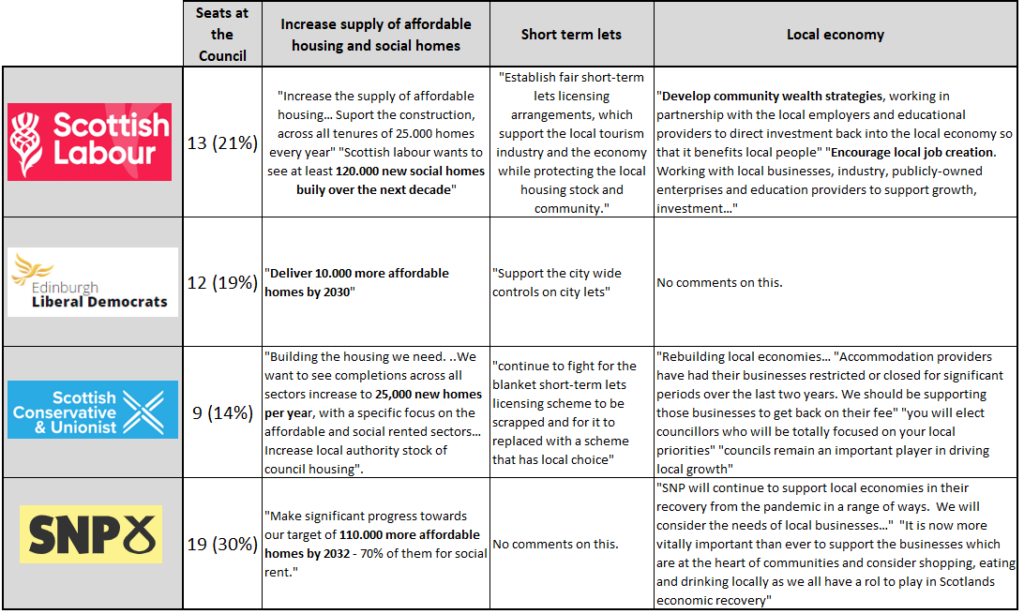
It’s evident that the major political parties converge on certain key ideas: the necessity of affordable housing, the intent to regulate short-term lets, and the emphasis on bolstering local economies. For a comprehensive understanding, you can explore their full manifestos at the following links: Scotish Labour, Edinburgh Liberal Democrats, Scotish Conservative & Unionists, SNP.
Shifting focus to local economies, it’s undeniable that a significant portion relies heavily on tourism. The Edinburgh 2030 strategy highlights this, stating, “Tourism is one of the city’s biggest success stories, attracting 4.3 million visits annually, with daily spending around £4 million. This sector employs over 33,000 of the city’s 513,000 residents, offering opportunities across various community segments.” These 33,000 direct jobs, along with countless indirect roles — such as taxi drivers, bartenders, tourist shop employees, hairdressers, farmers, and supermarket staff — all contribute to the city’s vibrancy. Importantly, these individuals are also voters.
Accommodation is a crucial need for tourists, which led me to delve into research on Edinburgh’s visitor accommodation sector. Surprisingly, the most recent study I could locate dates back to 2019: the “EDINBURGH VISITOR ACCOMMODATION SECTOR Commercial Needs Study 24th January 2019” . This report provides data on the number of hotel rooms, apartments, and hostel bedrooms. Regarding “Airbnbs,” it notes that “In September 2017 (the latest available data), Inside Airbnb identified 9,638 properties in Edinburgh registered with Airbnb.” Additionally, Arabella Stewart-Leslie, Senior Planner at Lichfields Planning, published an article on September 15, 2022, where she estimated Edinburgh’s “Airbnb” whole properties at 4,168 and “Airbnb” private bedrooms at 1,738. By amalgamating all these figures and estimating the average occupancy per type of unit, we arrive at the following insightful conclusions:
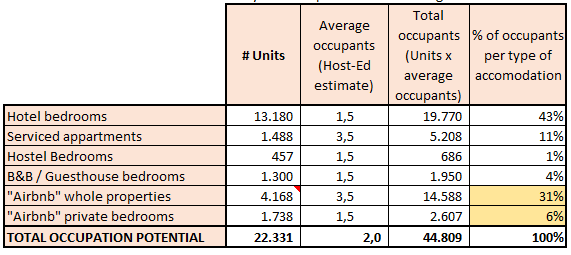
The implication that “Airbnbs” might be accommodating 39% of all tourists visiting Edinburgh is quite significant. If these figures are accurate, reducing their number to just 600 could potentially lead to a severe downturn in the city’s tourism-related businesses. My analysis, which is quite detailed and thus not fully elaborated here, estimates that Edinburgh had around 2,800 short-term lets in 2022.
A reduction of short-term lets from 2,800 to 600 would still have a substantial negative impact on the local economy. The immediate effect would be felt by those of us renting properties on a short-term basis. We would earn less, subsequently pay fewer taxes, and reduce our spending on purchases and dining out. However, the most significant impact would be on local businesses, which would lose a considerable portion of their revenue and on their employees.
Ironically, one of the groups most adversely affected would be our neighboring landlords. If short-term letting is restricted in their buildings, their property values are likely to decrease. This means that, quite suddenly, they could find themselves less wealthy or, in starker terms, poorer.
While some tourists would still visit Edinburgh, choosing hotels instead, it’s crucial to note that many of these hotels are not locally owned. To understand this better, let’s examine the list of major hotel chains in Edinburgh and their respective headquarters:
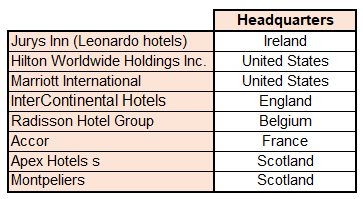
In conclusion, the ultimate judgment rests in the hands of the voters. They will evaluate politicians based on the fulfillment of their manifesto promises, scrutinizing whether the affordable housing was indeed built and if the local economy was genuinely nurtured. The notion that short-term rentals were the city’s primary issue is unlikely to convince them. Instead, a well-informed electorate may conclude that the Council’s approach to short-term lets was, perhaps, a misdirected endeavor.
Good analysis. As ever, challenging to get into the detail in a blog post.